
This page contains affiliate links. Please read our disclosure for more info.
Our Iceland winter road trip took us to glaciers, black sand beaches, and endless waterfalls.
We rode adorably fluffy Icelandic horses, soaked in hot springs, and attempted to see the northern lights.
For our 8-day self-drive trip, we focused on the Golden Circle and South Iceland, as these are most accessible in winter.
In this Iceland winter itinerary, I share our route (including famous sights and off-the-beaten-track gems), where we stayed, and tips for visiting Iceland in winter.
Contents
Iceland in Winter: What to Expect
Here are some tips specific to Iceland winter travel. For more advice, see my guide to Planning a Trip to Iceland: Dos and Don’ts.
Weather

Iceland doesn’t get as cold as you might think in winter. During our late January trip, temperatures ranged from -3ºC to 4ºC (27ºF to 39ºF), which is about average.
The wind chill factor can make it much colder, though, so do pack plenty of warm layers as you’ll be spending most of your time outside.
We packed similar clothes as for our trip to Norway—see our Tromso winter packing list.
Rain or snow is always a possibility, but we didn’t have much rain and no snow (it was an unusually unsnowy winter). I highly recommend a waterproof jacket and shoes or boots.
We brought our microspikes with us, but didn’t need them. I do recommend them in winter in Iceland, though, as trails can get icy and they help you avoid slipping.
Daylight Hours
At the beginning of January, there are 4.5 hours of daylight in Reykjavik.
That increases rapidly, and by the end of January, we had 7 hours of daylight with sunrise at 10.10am and sunset at 5.10pm.
I’m glad we visited later in the month to have more hours to explore.
You can check sunrise and sunset times on Time and Date.
You should also look at the Civil Twilight times. This means the time before sunrise or after sunset when there’s enough light to see. This gave us about an hour extra at each end of the day.
The advantage of visiting Iceland in winter is the gorgeous golden light all day (at least when the sun shines). You also don’t have to get up early to enjoy the sunrise!
Driving Conditions
Driving conditions vary during winter, which is why we stuck to the south, where roads are more likely to be clear. Driving the full Ring Road (Route 1 all the way around the island) in winter is risky, as roads can close.
You should be prepared to drive on snow and ice. If you aren’t confident with that, it’s safer to base yourself in Reykjavik and take bus tours.
As Iceland had minimal snow before our trip, all the roads were clear for us. We had a little bit of ice on some mornings, but nothing of concern.

Before you head out each day, it’s essential to check the road conditions. We used the Faerd & Vedur app, or you can check the Umferdin website.
A regular car should be fine for this route. We rented a compact SUV just in case, though. We rented from Europcar at Keflavik Airport and had no problems. I usually compare the best deals and book through Booking.com.
Another essential app for this trip is Parka, which allows you to pay for parking at many attractions (some don’t have machines).
Expect to pay around 1000 ISK ($8/ £6) for parking almost everywhere. There were no entrance fees on this route, though, except for hot springs.
Make sure you have an affordable international data plan or buy an eSim from Airalo—it worked well for us and we had good signal everywhere.
Northern Lights
There’s a chance of seeing the northern lights throughout the winter in Iceland.
Sadly, we didn’t get lucky on this trip (we did see them on our Westfjords trip in late September).
To check the chances of seeing them and if the skies will be clear, use the Aurora app.
Our Iceland Winter Itinerary at a Glance

We had 8 nights in Iceland at the end of January and beginning of February.
This was our route—we mostly avoided towns to focus on nature and increase our chances of seeing the northern lights from rural accommodation.
We self-catered everywhere except for our last night in the capital.
We loved everywhere we stayed (except the guesthouse in Reykjavik, which was fine for the price).
We used Booking.com to book everywhere about five months in advance.
Booking so far in advance isn’t always necessary in winter, but it gave us more options. The owner of Akurgerði said she is almost always booked up year-round. Winter isn’t as quiet a time as it used to be.
Airbnb is also worth checking if you want self-catering accommodation.
If You Have Less Time
7 Day Iceland Winter Itinerary
If you have 7 nights, I would reduce the Golden Circle by one night or skip either Hvammsvik (if you’re not interested in hot springs or it’s over budget) or Reykjavik.
Personally, I wished we’d skipped Reykjavik as I prefer spending time in the countryside. Being close to the airport on your last night is a good idea in winter, though, even if you have a later flight. And for your first trip, you’ll likely want to experience the capital.

5 Day Iceland Winter Itinerary
With just 5 days in winter, I think it’s sensible to skip the Skaftafell area and Hvammsvik (even though they were our favourite areas). I would suggest 2 nights Golden Circle, 2 nights in Vik, and 1 night in Reykjavik.
That said, our friends at Bridges and Balloons did this 5 day Iceland itinerary to Reykjavik, the Golden Circle, and South Coast (including a glacier ice cave tour), so it is possible to follow most of our route in a shorter period.
Some of their travel days were longer than we wanted, though, and involved driving in the dark. You definitely don’t want to try this if you aren’t experienced driving in winter conditions.
Map of Our Iceland Winter Road Trip
This map shows all the places we visited on our Iceland winter trip.
I have added pins to the parking areas of each attraction where possible, so you get more accurate driving directions/times.
Our Iceland Winter Road Trip in Detail
Day 1: Airport to Golden Circle (3 Nights)
Drive from Keflavik Airport to Akurgerdi: 1 hour 20 minutes / 96km (60 miles).
Our flight arrived at Keflavik Airport (KEF) at 5.15pm, so we had to drive in the dark, which was fine, but it would be better to arrive earlier.
It took us about 45 minutes to get through immigration, collect our suitcase, and pick up our rental car.
We then stopped at the supermarket, Krónan Reykjanesbæ, 10 minutes away, which had a good selection (including vegan options).
We arrived at our cabin at 7.30pm and had an easy frozen pizza dinner.
Where We Stayed: Akurgerði Guesthouse

We absolutely loved our little one-room cabin, Akurgerði Guesthouse 8, which is one of four on a horse farm between Hveragerði and Selfoss.
The decor is so unique—ours had lots of horse-themed details, using old wood and farm equipment.
The highlight was the hot tub on the terrace.

While this area doesn’t feel as remote as later in the trip (we could see a road and town lights in the far distance), the views were still good.
It’s a handy base for the Golden Circle and not too far from the airport.
Day 2: Golden Circle Waterfalls and Geysers
Drive from Akurgerdi to Gulfoss and Back: 2 hours 20 minutes / 160km (99 miles).
Today we visited two of the three main attractions on the Golden Circle. This popular sightseeing route is the most popular day tour from Reykjavik. We much preferred exploring at our own pace.
We were out from 10.30am to 5.30pm.
Gulfoss Falls

We started with the farthest-away attraction, then made stops on our way back.
Gulfoss is a huge, iconic waterfall with multiple gushing cascades in a river.
There’s free parking (rare in Iceland!), and it’s an easy 5-minute paved walk to the upper viewpoint.
We spent about 30 minutes braving the wind and walking to various viewpoints to see it from different angles. The lower trail can be icy, so microspikes are often needed (but not for us).
Gulfoss is truly spectacular, and the most epic of the 12 waterfalls we visited on this trip (it ended up #3 in our personal rankings).
Afterwards, we had a nice lunch (panini, apple pie, hot chocolate) in the cafe, which wasn’t too busy. There’s also a gift shop and toilets.
Geysir

10 minutes back down the road is another extremely popular stop. The Geysir area is a steaming geothermal landscape of hot streams and bubbling pools.
It’s an easy walk (although it can be icy) to see the main attraction, Strokkur Geyser, which erupts every 10 minutes or so.
We waited to see three eruptions, and they varied in size. It’s a fun and easy stop.
Parking was 1086 ISK in the Parka app. There’s a shop, a busy restaurant, and toilets.
Faxafoss

We were ready for a less crowded attraction, and Faxafoss was perfect—we had it to ourselves!
Parking is 900 ISK—unusually, you pay an attendant at the entrance (card payments are fine—we didn’t use cash our whole trip).
It’s a few minutes’ walk to the upper viewpoint and maybe 5 minutes down to the water.
We loved that we could get right up to the wide and powerful falls. It was also sheltered from the wind.
There are no toilets here, and the cafe was closed.
Laugarás Lagoon

Our final stop was for a relaxing soak in one of the many geothermal hot pools in the area.
We chose Laugarás Lagoon, which opened in 2025, and were able to get in without a booking at 2.45pm.
The facilities are modern, and it wasn’t too busy.
There are large pools on two levels with a swim-up bar and waterfall. It’s more of a place to wander around or sit and enjoy the river views than to actually swim.
I really enjoyed alternating between the sauna and cold plunge pool, which you don’t find at all hot springs in Iceland.
It was the perfect end to the day. Their restaurant is supposed to be excellent, but we went back to our cabin to cook.
Day 3: Horse Riding and Thingvellir National Park
Drive from Akurgerdi to Thingvellir and Back: 1 hour 40 minutes / 105km (65 miles).
Horse Riding

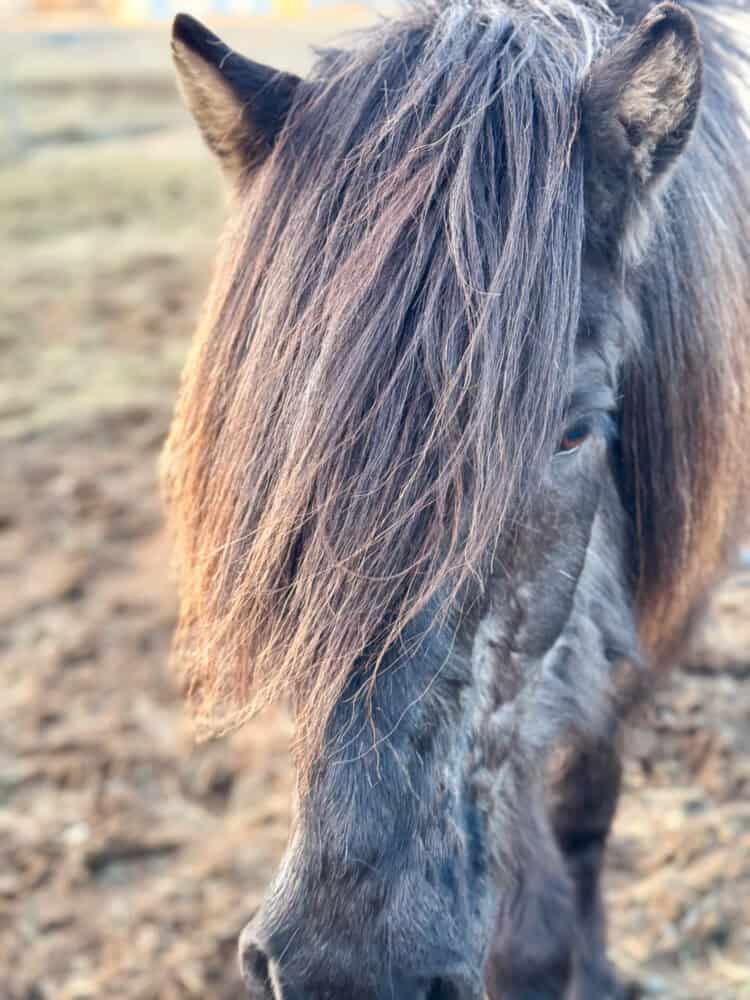
As we were staying on a horse farm, we couldn’t miss out on a ride on the Icelandic horses, extra cute and fluffy in winter.
The friendly owner of Akurgerdi Farm, Sabine, took us out for a private hour-long ride (20,000 ISK per person).
The horses were lovely, the scenery beautiful, and we appreciated that Sabine was happy for us to tolt (the unique Icelandic pace) and gallop. This is not a nose-to-tail riding place, although she can cater to all levels.
Thingvellir National Park
After lunch at our cabin, we drove to the third major attraction on the Golden Circle—Thingvellir National Park.
This is a UNESCO World Heritage site where the first parliament was held in 930AD.
It’s also where North American and Eurasian tectonic plates meet, and a pretty place for an easy walk.

We parked at Þingvellir Parking P1, which is a short walk from the visitor centre. Parking is 1000 ISK and you pay at a machine in the visitor centre.
There are toilets, a small shop, and a basic cafe with baked goods and sandwiches (I enjoyed some Icelandic Happy Marriage Cake after our walk).
This is a tour bus stop, so it was a little busy at first. You don’t have to walk far from the first viewing platform to leave the crowds behind. By the time we left at 3pm, it was much quieter.
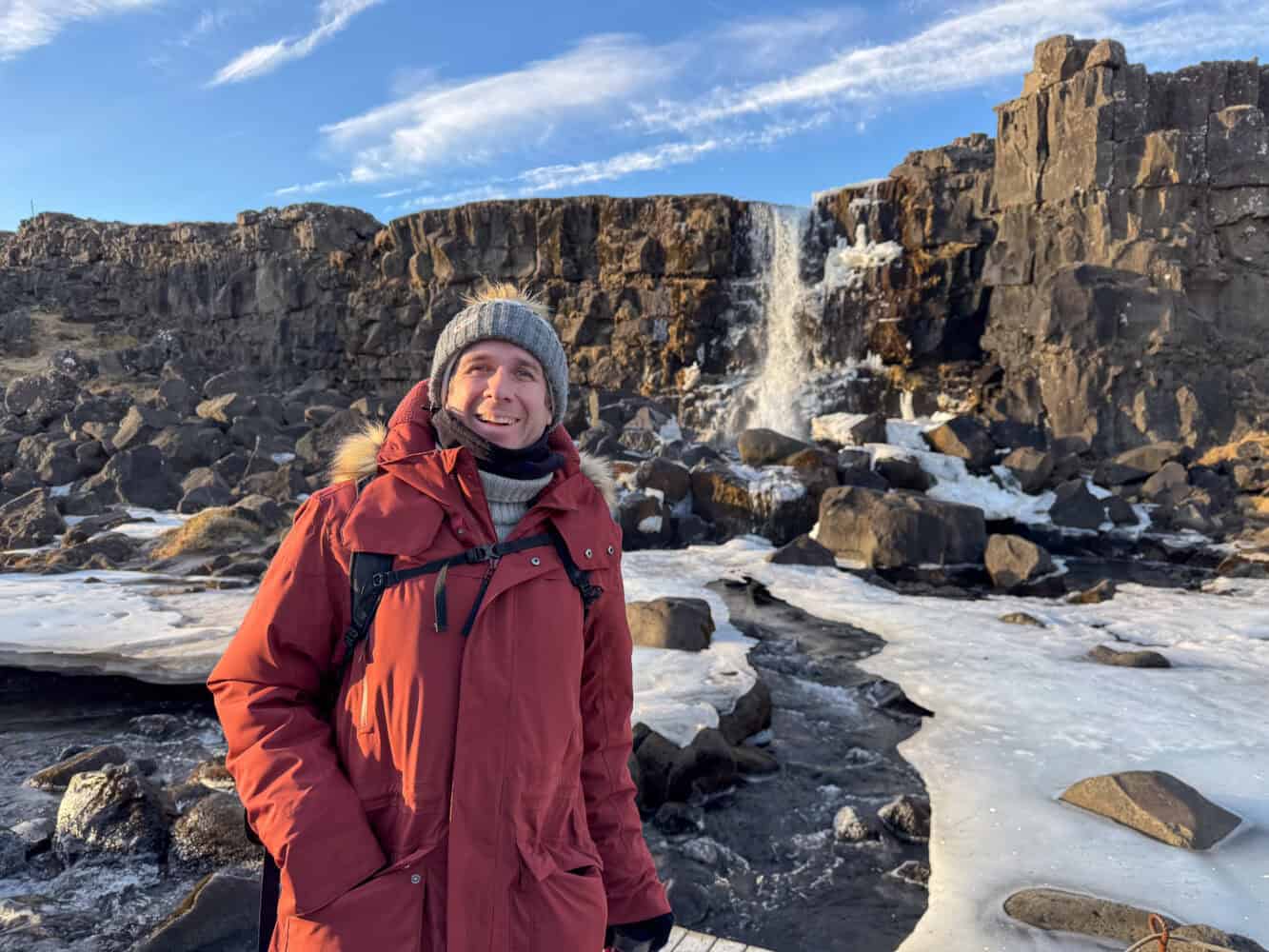
We did this 5km loop trail to Oxararfoss Waterfall, which took us to most of the major sights in about 1 hour and 15 minutes.
Day 4: Drive South Coast to Skaftafell (2 Nights)
Drive from Akurgerdi to The Potato Storage: 4 hours / 289km (180 miles).
Today we moved on to the south coast with a full day’s driving and stops at some stunning waterfalls. We were lucky to have a glorious, sunny day.
Allow plenty of time for this drive, as all the amazing stops take longer than you’d think. We were out from 9.30am to 5pm.
First, we restocked with groceries at Kronan supermarket in Selfoss and filled up with petrol.
The landscape was fairly flat until we hit the coast, and then the views were spectacular.

Seljalandsfoss

The downside of driving in Iceland in winter is the limited light and the inability to get an early start to avoid the tour buses.
We really felt this when we arrived at Seljalandsfoss at 11.15am, as it was so crowded that it was hard to enjoy.
It’s a dramatic waterfall with a large drop. In winter, the path behind the falls was closed.
We also walked 10 minutes on a rather icy trail to Gljúfrabúi, a waterfall inside a cave. The entrance is narrow, and there are only a few rocks to stand on inside, so it seemed too stressful to try to go in with the large crowds.
Parking is 1000 ISK, and you pay at a machine. There are also toilets and a small stand with coffee, baked goods, and sandwiches.
Skógafoss

It’s a stunning 30-minute drive further along the coast to another major waterfall.
While Skógafoss was also busy, we found it so spectacular that we didn’t mind as much.
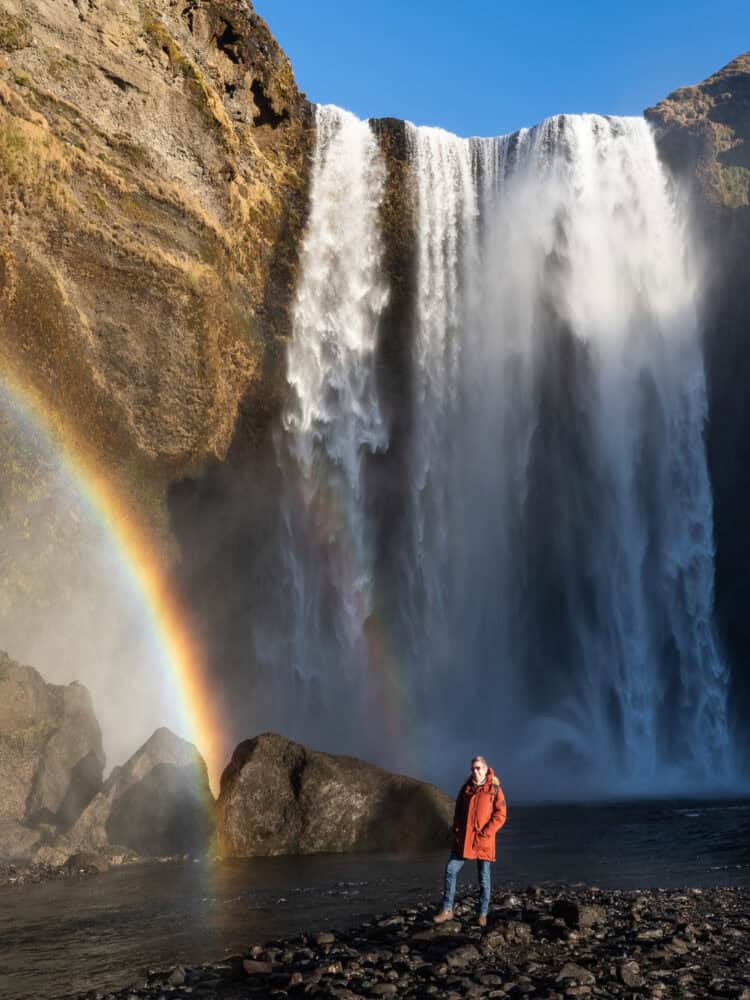
You can get right up to the bottom of the powerful falls. The golden midday light was stunning in winter, and we even had a perfectly arched rainbow!
You can also walk up many stairs to see the waterfall from above, but we were concerned about time and skipped it.
Parking is 1000 ISK with the Parka app. There are also toilets and a hotel with a restaurant.
Kvernufoss

Kvernufoss is only 5 minutes from Skogafoss, but there were only a few other people around. It ended up being our favourite waterfall.
We parked at Kvernufoss parking lot just past the Skogar Museum. There are no facilities, and the museum cafe is closed in winter. Parking is 750 ISK in the Parka app.
The walk to Kvernufoss takes about 15 minutes through a field, then into a gorge beside a pretty river. It feels very peaceful.
The waterfall has a dramatic setting inside the gorge. You can get up close and even walk behind it (without getting wet).
Vik
Back on Route 1, we continued along the coast with a beautiful glacier view.
30 minutes later, the drive into the small town of Vik was also lovely with its red-roofed wooden church perched on a hill overlooking the sea.
We didn’t stay long in Vik as we’d be returning in a few days. We grabbed a coffee and a cake at Lava Bakery in a big tourist centre (nothing special but convenient).
We also had a quick walk on the dramatic Víkurfjara Black Sand Beach across the road.

We still had two hours to go, so we moved on, passing more craggy mountains in even golder light, a strangely flat area, a lava field, and then back to the mountains.
There are a few good stops on this stretch, but we saved them for the way back in two days.
The only brief stop we made was at Fossalar, a free parking area by a river with stunning views.

The final stretch as we approached Skaftafell Glacier was just incredible—snowy mountains glowing orange as the sun set with a full moon above.

Where We Stayed: The Potato Storage

We stayed at The Potato Storage, a family-run guesthouse with five apartments in an old potato shed.
The location was ideal, just 10 minutes past Skaftafell, where we wanted to hike, and 40 minutes before the famous Jökulsárlón Glacier Lagoon.
We chose the bigger one-bedroom apartment at the front with beautiful mountain views.
It was clean, comfortable and well-equipped.
This peaceful spot would be ideal to see the aurora, but we didn’t get lucky.
Day 5: Glaciers and Svartifoss Hike
Drive from Potato Storage to Jökulsárlón and Skaftafell and Back: 1 hour 45 minutes / 118km (73 miles).
Today was all about glaciers. This area is home to the massive Vatnajökull National Park, which includes Iceland’s largest glacier.
We chose not to take a tour onto the glacier to see ice caves, as we had done that on a previous trip (on a different glacier).
These tours are a highlight for many, so you might consider one such as the Skaftafell: Blue Ice Cave & Glacier Hike on Vatnajökull with Arctic Adventures, which starts just 10 minutes from The Potato Storage.
Jökulsárlón Glacier Lagoon and Diamond Beach

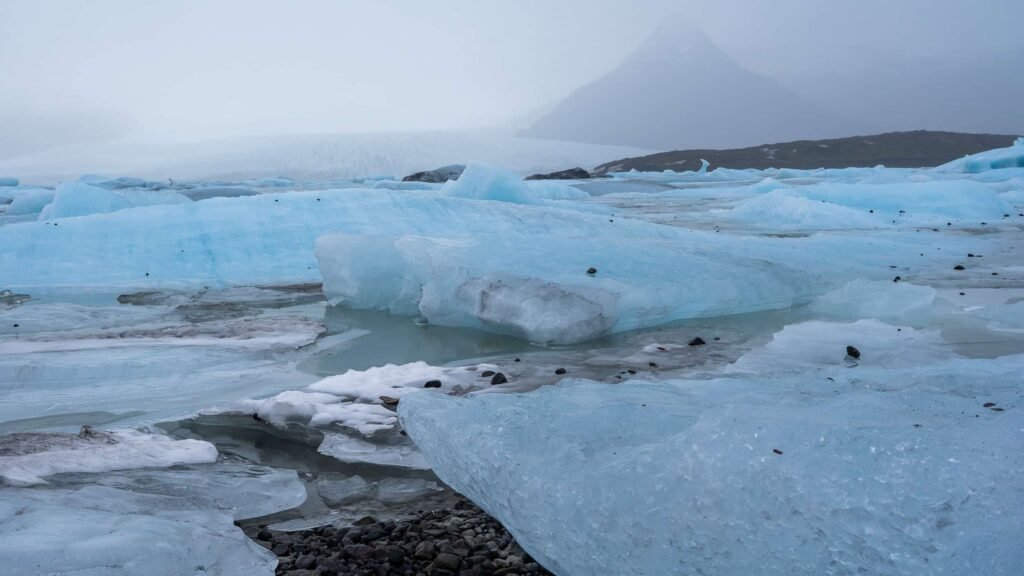
Jökulsárlón Glacier Lagoon is one of the most famous attractions in Iceland, with icebergs floating in a lake at the edge of a glacier.
In winter, you can’t kayak or take a boat trip on the lake, but there are more icebergs to see.
We arrived around sunrise at 9.50am on a rainy morning. There were already a few tour buses, but it didn’t feel too crowded. I imagine it gets a lot busier later in the day.
Parking is 1126 ISK in the Parka app and covers the parking area across the road at Diamond Beach, too, but we just walked over.
There are toilets, a basic shop/cafe with coffee, baked goods and soup, and some food trucks (closed in the morning).
From the large car park, it’s a quick walk to the edge of the lagoon. It’s so impressive! The water is full of ice chunks in all shapes and shades of blue and white.
You can walk along the lagoon and up to a viewpoint, but it looks amazing from anywhere.

We then walked along the lagoon under a bridge and over the road to Diamond Beach.
The icebergs wash up on this black sand beach, and it’s an incredible sight, like nowhere else we’ve visited. You can get up close to endless chunks of ice, some huge. Some are crystal clear, while others glow blue.


We spent ages exploring and even saw a seal swimming in the sea.
This is an example of a popular tourist attraction that very much lives up to the hype.
Fjallsárlón Glacier

But things got even better! We drove 10 minutes back along Route 1 and stopped at Fjallsárlón Glacier Parking.
Parking is free. Frost Restaurant is based here and has toilets that are free for customers or 200 ISK.
There’s a path to the right of the restaurant that takes you to Fjallsárlón Glacier Lagoon in about five minutes.
Incredibly, we had the lagoon entirely to ourselves! The lagoon is smaller than Jökulsárlón, which meant we could see the glacier more clearly.
Even on a rainy day, it was magical!
Hike from Skaftafell to Svartifoss
It was just 30 minutes back to our apartment, leaving the rain behind for sunny skies. Skaftafell is known for its microclimate and is sunnier than most of South Iceland.
After a lunch break, we drove the 10 minutes to Skaftafell Visitor Centre. This area is a nature reserve (part of the larger National Park) and the starting point for many hikes and glacier tours.
Parking is 1040 ISK (Parka app or a machine). There are toilets, but the cafe is closed in winter.
We did one of the shorter hikes—3.8km (2.4 miles) out and back to Svartifoss waterfall, which took us 70 minutes total with 178 metres (584ft) elevation gain.
It’s a steepish ascent to the waterfall, but not too challenging. We were boiling in our big jackets in the sun, though.
Svartifoss is unique because it’s surrounded by basalt columns, formed from lava.

It’s a beautiful waterfall, but the downside of this hike is the lack of glacier views.
Some longer routes include the glaciers, but conditions can be challenging in winter (spikes likely needed).
Day 6: Drive Skaftafell to Vik (1 Night)
Drive from The Potato Storage to Black Beach Suites: 2 hours 20 minutes/ 169km (105 miles).
It was time to start making our way back along Route 1. Although we covered the same ground as on Day 4, we made different stops.
The Skaftafell to Vik drive is only 2 hours, but we were out for about 6 hours with stops.
Svínafellsjökull Glacier

Our first stop was just 7 minutes from our apartment, and it was a highlight!
Svínafellsjökull is an easily accessible glacier, just a short drive down a gravel road off Route 1.
We parked at Svínafellsjökull Parking, which was free but had no facilities.
The walk to the glacier takes about 10 minutes on an obvious path with fantastic snowy mountain views.
This was another quiet spot that we had to ourselves until we were leaving.
You can walk right up to the glacier, which is stunning with carved blue ice backed by mountains.

Fossalar
We stopped at Fossalar again to eat our packed lunch in the car, with a view of the river and mountains.

Stjórnarfoss

In our quest to find quieter waterfalls, we stopped at Stjórnarfoss, a few minutes off Route 1.
Parking was free (no toilets), and we were alone.
You can see the waterfall from the road or walk a few minutes to get up close. While it’s not huge, it has a dramatic location in a gorge and is a peaceful spot.
Vatnajökulsþjóðgarðs Visitor Centre
The previous stops lacked toilets, so that was our main reason for stopping at the newish Vatnajökulsþjóðgarðs Visitor Centre in a cool grass-roofed building.
We used the facilities, bought a cake and hot chocolate (in winter, there was no other food), and had a quick look around their information on the glaciers and national park.
Fjaðrárgljúfur Canyon

Fjaðrárgljúfur is a stunning canyon reached by a paved road just five minutes off Route 1.
Parking is 1086 ISK on the Parka app. There are a couple of toilets, but no other facilities.
While you can see the canyon from near the car park, the best views are a 20-minute walk up a hill, where you can also see the beautiful waterfall, Mögárfoss.
Reynisfjara Black Sand Beach

We passed through Vik and picked up supplies at the Kronan supermarket (not as large as the others on this route, but still fine).
On the other side of Vik is Reynisfjara, a hugely popular black sand beach.
Parking is 1086 ISK in the Parka app, and there’s a restaurant.
The beach is right next to the car park. It’s wild and scenic with waves crashing into the cliffs. But it’s also immensely busy, so we didn’t spend long here.
You need to be extremely careful—don’t get anywhere close to the water. Tourists have been killed here by giant sneaker waves that come out of nowhere. Coastal erosion has recently made the beach smaller, making it even harder to walk on.
Honestly, this was one famous sight we could have happily skipped.
Where We Stayed: Black Beach Suites
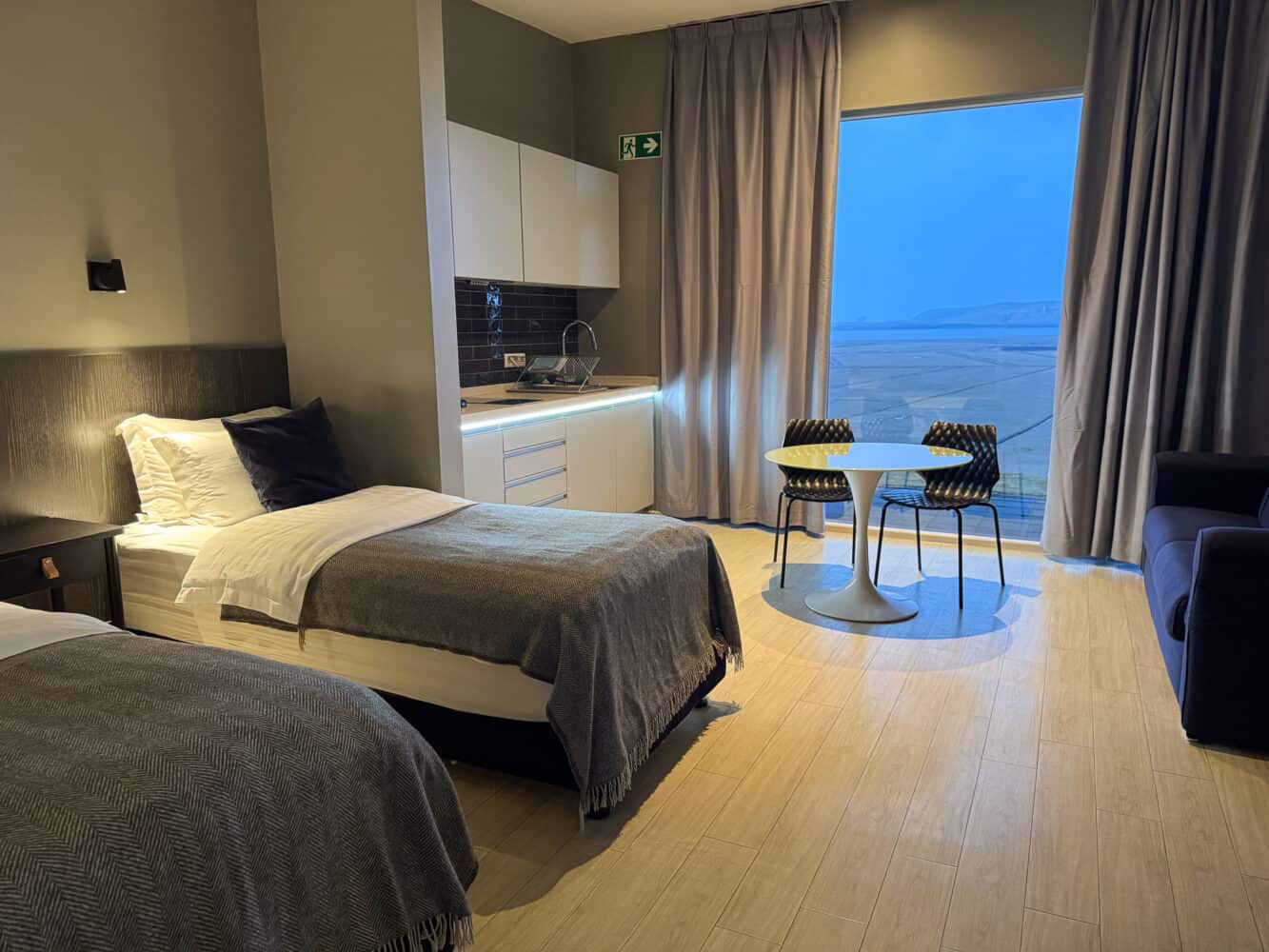
We stayed just 5 minutes from Reynisfjara at Black Beach Suites, which has multiple apartments with fantastic views of the surrounding countryside and coast.
We stayed in a modern, comfortable studio apartment. The kitchen wasn’t as well-equipped as the others we’d had, but it was fine for an easy pasta dinner.
The hostel next door also has a bar with snacks, and it’s a 10-minute drive back to Vik.
Day 7: Drive Vik to Hvammsvik (1 Night)
Drive from Black Beach Suites to Hvammsvik Nature Resort: 3 hours 20 minutes/ 229km (142 miles).
We could have made our way back to Reykjavik from Vik (2.5 hours), but I decided to take a detour an hour north of the capital to visit Hvammsvik Hot Springs.
On the way, we made some South Coast stops that we’d missed on Day 4 and drove through part of the Golden Circle again.
We were out driving (with stops) for about 5.5 hours today.
Solheimajökull Glacier Tongue

It was a 25-minute drive to Solheimajökull Glacier Tongue.
Parking is 750 ISK on Parka. There was a closed coffee truck. I believe there are toilets for a fee.
This is the base camp for many glacier tours, and at 10am several groups were walking up to the glacier.
It’s a 10-minute walk to a viewpoint, but you can’t get up close to the glacier without special gear and a guide.
While it was nice to see, our other glacier experiences were much better, so I would skip this one.
Gluggafoss

Our next stop was our second favourite waterfall of the trip (after Kvernufoss).
Gluggafoss is a 15-minute detour off Route 1 (just past Seljalandsfoss) on a bumpy gravel road.
Parking is 1000 ISK in Parka. There are no facilities except some picnic tables.
You can see the waterfall from the car park, but it’s worth the short walk along the river to get up close.
The waterfall has three tiers. You can walk behind the water on the first tier and walk right up to the middle tier.

It’s a stunning waterfall, and we were the only people there.
We had a one-hour drive to Selfoss from here—this route didn’t take us back on the gravel road.
Selfoss for Lunch
As we wouldn’t have a proper kitchen this evening, we stopped in Selfoss for a big lunch.
We had an enjoyable pizza in The Old Dairy Food Hall. Other options were burgers, Thai, pasta, dim sum, and tacos.
Þórufoss
Although we were back on the Golden Circle, we took a different route than previously (you could also go via Thingvellir). It was a scenic 50-minute drive on the 350 and 360 past lava fields and a frozen lake to Þórufoss.
This is known as a quieter stop on the Golden Circle, and there were only two other cars in the free car park (no facilities).
Þórufoss didn’t live up to our expectations, partly because the waterfall was in shadow, and also because to reach it, you had to scramble down some rocks, which didn’t feel appealing in the extremely strong winds we had. The path down isn’t obvious.
One to try another time.
Hvammsvik Hot Springs
Hvammsvik Hot Springs is 20 minutes from Þórufoss.
The location is stunning on Hvalfjörður (Whale Fjord), and there are cottages to rent, as well as hot springs open to the public.
We splurged on one of the beautiful cottages (see below) and, after checking in, went to relax in the hot springs.

Hvammsvik has a more natural setting than many of Iceland’s paid geothermal baths. There are 8 smallish pools of varying temperatures on a beach overlooking the fjord.
The big appeal for me was being able to cold plunge in the sea (a chilly 3ºC/37ºF!) before warming up in the pools and steam room.
Definitely take or rent water shoes if you want to go in the sea, as the beach is rocky.
Even if (like Simon) you don’t fancy braving the cold, this is a lovely place to relax, especially at sunset when the mountains glowed orange.
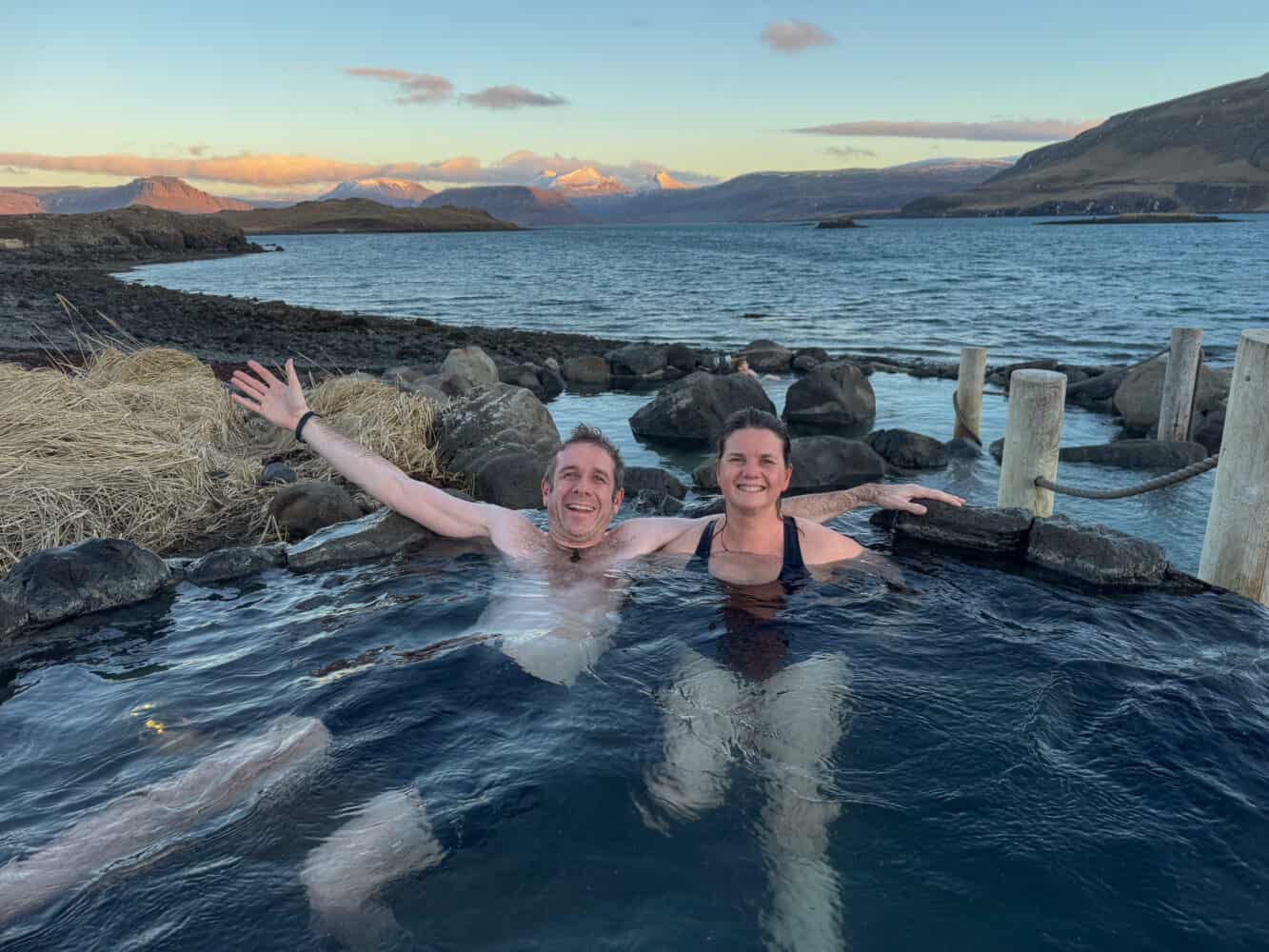
Hvammsvik was definitely our favourite of the three hot spring resorts we visited on this trip.
Where We Stayed: Artist Lodge at Hvammsvik

Hvammsvik Nature Resort has a few larger houses to rent, but we went with the one-bedroom chalet called an Artist Lodge (they feature real artwork).
It was pricey but worth it, and we wished we’d had more than one night.
The setting of the resort is beautiful with fjord and mountain views. It feels far away from it all.
We loved the views from our cabin, the modern, stylish design, and comfy double bed (in a country where twins are the rule).
The only downside was the lack of a proper kitchen (the bigger houses do have them). We did have a toaster, kettle, coffee pod machine, and plates/cutlery, etc.
We made toast for dinner and breakfast. You could also order a snack or breakfast basket, or eat in the bistro at the hot springs (limited menu).
Guests get a 25% discount off the entrance to the hot springs, which are a 15-minute walk (or short drive) away.
There’s also a free natural hot spring (no facilities) on the fjord, a 20-minute walk away (we didn’t have time to try it).
Of all the places we stayed, Hvammsvik is where we most want to return.
Day 8: Drive to Reykjavik (1 Night)
Drive from Hvammsvik Nature Resort to Reykjavik: 50 minutes/ 54km (34 miles).
After a morning session at the hot springs (so nice!), we had lunch at the bistro (the coconutty vegan soup was pretty good), then drove the 50 minutes south to Reykjavik.
Reykjavik
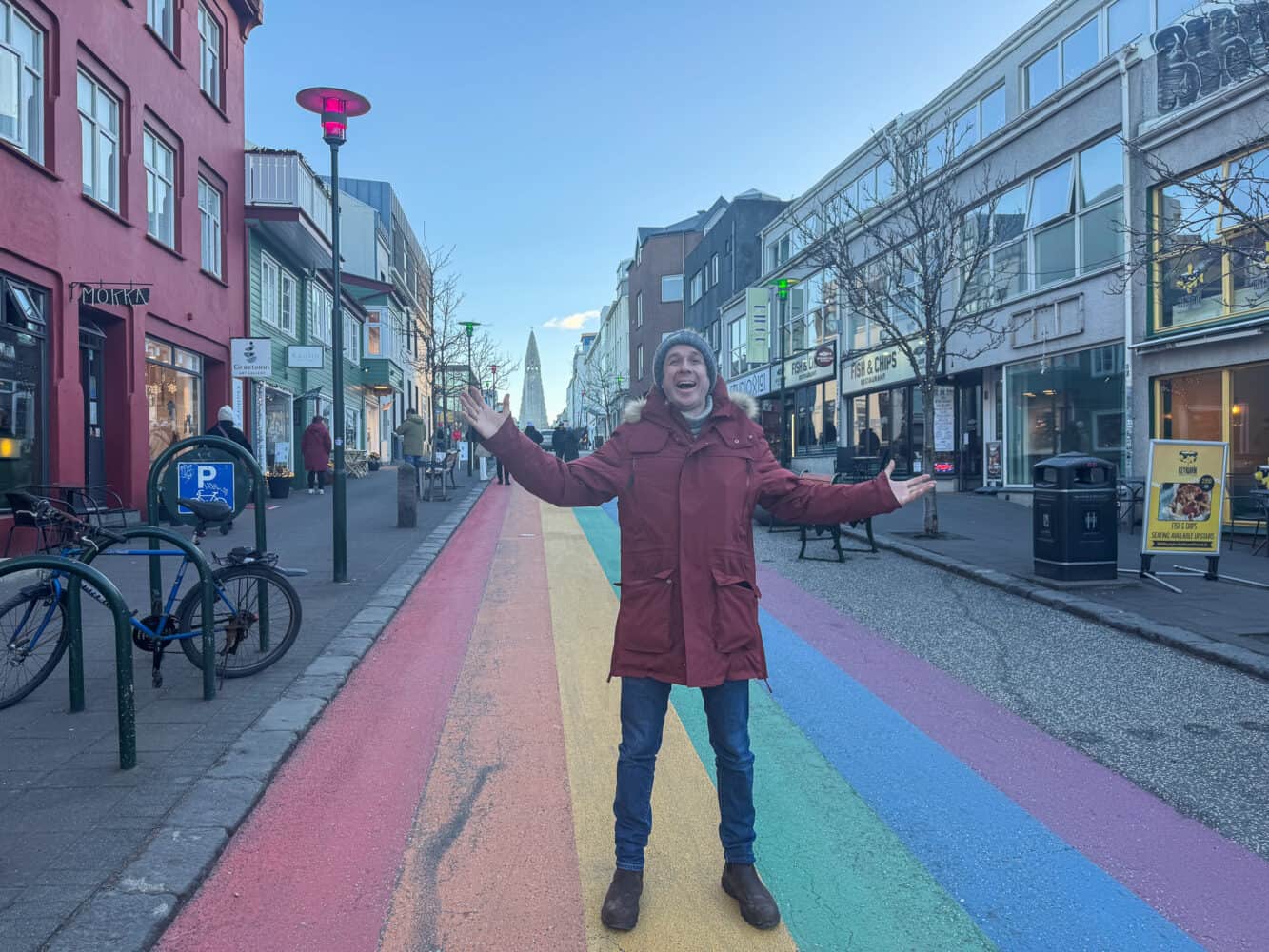
We spent the afternoon wandering past sights like Hallgrimskirkja Church, Rainbow Street, and Harpa Concert Hall, and grabbed an AeroPress coffee in Reykjavík Roasters.
Dinner was a veggie poke bowl from Pósthús Food Hall, which has a good range of options in a stylish space.
Where We Stayed: Guesthouse Galtafell
I chose Guesthouse Galtafell because it was the cheapest double ensuite room in the centre with free parking (on the street though).
Unsurprisingly, it was our least favourite accommodation. Our room was simple (and there was noisy plumbing above us), but it was fine for one night, and we could walk everywhere.
Day 9: Blue Lagoon and Departure
Drive from Reykjavik to Keflavik Airport via Blue Lagoon: 1 hour 10 minutes/ 72km (45 miles).
On our final morning, we had breakfast at Sandholt Cafe. My advice—skip the cinnamon buns; the poppyseed bun was better, and other pastries looked good. They also have hot breakfasts.
The cinnamon buns at Braud & Co are much nicer, so we got a takeout for later.
Blue Lagoon

As our flight wasn’t until 6pm, we spent our last afternoon at the Blue Lagoon, which is just 20 minutes from the airport (50 minutes from Reykjavik). An 11am booking gave us more than enough time.
Our expectations were fairly low for Iceland’s most popular attraction, as we don’t love very busy places.
And yes, it was busy, but I still enjoyed it. The lagoon is so huge that you can easily find quiet spots, and the steam obscures other people to a certain extent.
The man-made lagoon is a surreal place, with vibrant blue water set amid a moon-like lava landscape and a geothermal power plant steaming next door.
As well as the massive main pool, there are two steam rooms, an attractive sauna (not hot enough for me), a swim-up bar (one drink is included in the basic plan), and a face mask bar (silica mask included).
I spent about 2.5 hours in the lagoon (including getting changed). Afterwards, we had lunch in the casual cafe. Food was prepackaged, but the vegan chickpea and salad wrap was pretty good and big enough to share.
There’s also an expensive restaurant.
While it was not my favourite hot spring, the Blue Lagoon is worth visiting if you’re trying a few, especially if you have time to kill before or after a flight.
Is Iceland Worth Visiting in Winter?
Iceland is definitely worth visiting in winter! I would happily visit Iceland at any time of year.
The upsides of winter are lower crowds (although tour buses were still out in force at popular spots), slightly lower prices, the chance to see northern lights, gorgeous golden light all day, and, potentially, beautiful snowy landscapes.
You also really appreciate the hot springs, and it’s the best time to visit the glaciers.
The downsides are limited daylight (visiting later in the winter helps), browner landscapes, and the chance of road closures (and tour cancellations) due to snow and ice.
While we got lucky and had no problems, you do need to be flexible, as the weather could delay your plans or make some areas inaccessible.
Also, if you are not confident driving on snow, I would skip a winter trip.
The weather is unpredictable year-round in Iceland, so I think it’s a magical place to visit in any season; it just depends what you are looking for.
More Iceland Posts
Read more of our Iceland travel tips in our other posts:
