
This page contains affiliate links. Please read our disclosure for more info.
TeamLab is an art collective that creates immersive digital art installations worldwide, many of them in Japan.
In Tokyo, there are two Teamlab museums—Borderless and Planets.
We’d visited a previous version of TeamLab Borderless before, but in 2024, they moved to a new permanent location in Azabudai Hills and added some new rooms.
On our latest trip, we visited the new Borderless. In this post, I share my TeamLab Borderless review and tips to make the most of your visit.
Contents
TeamLab Borderless Location
TeamLab Borderless is the most central of the two Tokyo TeamLabs. It’s located in the MORI building in Azabudai Hills, a shopping and office complex.
You can see the TeamLab Borderless location on Google Maps.
See below for how to get there.

TeamLab Borderless Hours
TeamLab Borderless opening hours and closing days vary, so it’s best to check the Borderless website.
It is currently open from 8.30am – 9pm, but in October, when we visited, it opened at 8am.
En Tea House opens 30 minutes after the museum and has its last orders an hour before closing.
Best Time to Visit TeamLab Borderless

The best time to visit TeamLab Borderless is at opening on a weekday.
TeamLab is very popular, so we like to book the earliest slot and arrive 20 minutes early to be one of the first in.
This worked well for us at TeamLab Borderless at 8am. We were amongst the first five people inside the museum, so the first 30 minutes were really quiet.
If you can’t get the first slot, I would choose an evening time around 6pm or 2-3 hours before closing.
Avoid weekends and public holidays if you can.
TeamLab Borderless Price and Tickets
TeamLab Borderless ticket prices vary by date and time. For adults, it costs from 3600 yen (US $23) to 5600 yen ($36). Weekends and holidays are more expensive.
You must book in advance for a specific date and time.
They do offer a Flexible Pass where you can enter at any time (on a specified date), but it costs three times the usual price, so I don’t recommend it.
Tickets go on sale 2-3 months in advance. You might be able to get an afternoon or evening time if you book last minute, but if you want the first slot, I recommend booking 1-2 months ahead.
You can book on the TeamLab website or on the authorised reseller Klook. We’ve used both with no problems. Sometimes they have different availability, so it’s worth checking both.
The official website allows you to change dates 3 times (until 2 hours before your booking), whereas Klook doesn’t allow changes.
You can add an En Tea House tea ticket to your booking on the official website. We did this, but there’s no real advantage (other than paying for everything at once) as you still have to queue at En to order.
If tea house tickets are sold out online, they will still be available at the museum.
How Long to Visit TeamLab Borderless
I would allow 2-3 hours for a visit to TeamLab Borderless.
We spent 2 hours at TeamLab Borderless, including colouring a picture in Sketch Ocean and drinking tea at En Tea House.
We were lucky at the beginning of the day with low crowds and no waits to get into rooms. Later in the day, expect more queues.
We were also tired with jet lag, so we didn’t repeat any rooms, which you might like to do (the artwork does change).
What to Wear

Unlike at TeamLab Planets (where you have to take off your shoes), there are no rules on what to wear at TeamLab Borderless.
There are mirrored floors, so avoid skirts or wear shorts underneath.
It’s best to wear comfortable shoes and clothes that you will be happy wandering around in for a few hours.
While you can take small bags into the museum, we like to leave jackets and backpacks in the free lockers and walk around unencumbered.
If you want to stand out amongst the projections in photos, I would wear plain clothes, perhaps in black.
What to Expect at TeamLab Borderless
On Arrival
TeamLab Borderless is located in a building that feels like a shopping mall. When you reach the building, follow the signs for the entrance.
Once inside, take the escalators down into the basement where the museum is located.
We arrived 20 minutes early for our 8am slot and were the first in the queue. It did fill up fast behind us, so it’s worth arriving before opening.
If you have a later time slot, there’s no need to arrive early.
We were let in a few minutes early to use the lockers, then held at the ticket gates until 8am, when you can scan your tickets to enter.

There are free lockers on the right as you enter (before the ticket gates), so I recommend dropping off your stuff quickly.
Umbrellas, large bags, food, and drinks without lids are not allowed into the museum.
The locker room has space to lock up umbrellas, strollers, and suitcases.

There are no toilets at the entrance, so make sure you find some elsewhere in the building before you join the queue.
Once we scanned through the ticket gates, we were shown a short video explaining how the museum works and that there’s no set route.
Then we were free to enter.
The No-Route Experience

There is no set route, map, or room signs in TeamLab Borderless. The idea is that you immerse yourself in the art without borders and explore.
The only signs you’ll see are for En Tea House, toilets, and the exit.
Honestly, I wasn’t sure I’d like this and thought it might be confusing. But it was really fun wandering down corridors and looking into doorways, not knowing what you’d get.
Some people advise rushing to the busier rooms first, but I don’t recommend that. You won’t know where they are anyway, and it’s best not to stress about it.
If you enter first as we did, you’ll naturally end up ahead of the crowd.
Once we’d visited everywhere, we did a second loop to check we’d been in all the rooms, and we hadn’t missed anything.
You might want to revisit some rooms, as the artwork is constantly changing.
Below is the route that we followed. Yours may be different, but don’t worry about it.
There are signs at the entrance to each room with their names, and you can use the TeamLab app for more information.
Flowers and People

The first room you enter is Flowers and People, Cannot be Controlled but Live Together – A Whole Year per Hour.
It’s typical TeamLab—bold and colourful with changing projections of flowers on massive walls.
The flowers grow, blossom, and wither. The images are constantly changing, but it’s not pre-recorded—the interaction between people and the installation causes the changes, so it will never be replicated exactly.
We didn’t linger in this room at first because we wanted to get ahead of the crowd, but we came back at the end, and it looked very different.

Universe of Water Particles

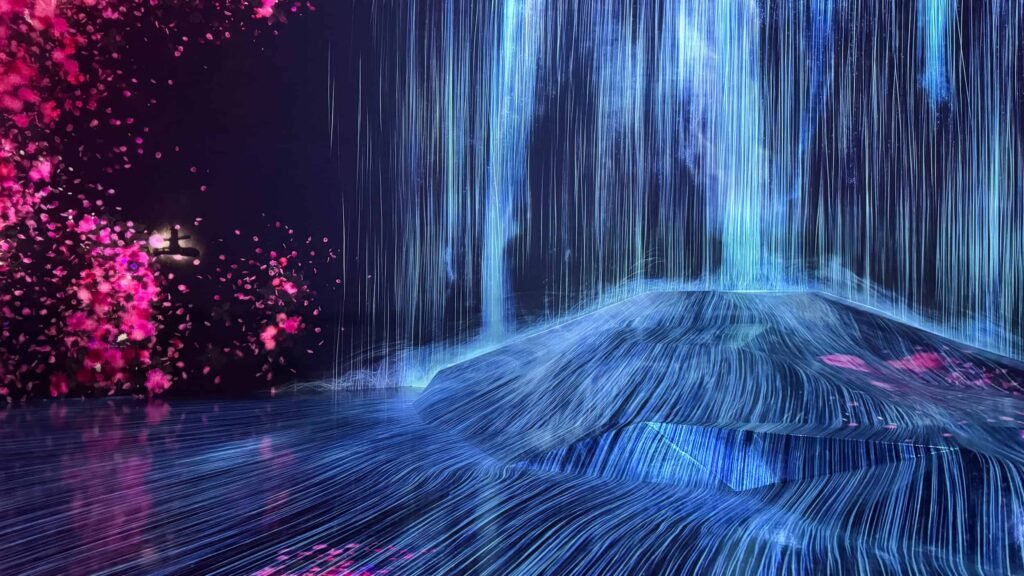
We entered the large waterfall room next, officially called Universe of Water Particles on a Rock where People Gather.
It’s a beautiful space where projections look like a waterfall hitting a rock.
You can walk up on the rock, and we managed to have it to ourselves for a moment, which is rare!
At the end of our visit, the room was much busier.


From here, you can venture down the dark corridors and choose a room to enter.
The art continues into the corridors, with walls lit by projections, such as animals walking alongside you.

Sometimes the art even enters neighbouring rooms, changing the installation.
Infinite Crystal World

Infinite Crystal World is TeamLab’s most iconic room. It’s one of the few repeating rooms with similar spaces at TeamLab Planets and TeamLab Biovortex Kyoto, although this one felt bigger.
Strings of LED lights hang from the ceiling, frequently changing colour.
With mirrors on the floors and walls, you are reflected behind and below, creating a trippy, infinite feeling.
Amazingly, there were only two other people in there when we arrived.

Memory of Topography

In Memory of Topography, the room has varying elevations to evoke a mountain landscape.
You walk up and through discs illuminated like plants and flowers, changing with the seasons. Your presence, immersed in the space, also creates change.

Dissolving Light and Other Rooms

The Dissolving Light space features a few art installations at different times.
It’s a small smoky room with flower projections. We had it to ourselves, and it felt very immersive.
We visited a few small rooms after that, which I don’t have names for.

Bubble Universe

Bubble Universe was one of our favourite rooms. You’re only allowed to stay inside for 5 minutes (I imagine there’s a queue at busier times).
Spheres of light hang from the ceiling, changing colour, and reflecting in the mirrored floor and walls, so it feels like there are an infinite number of them.

As always in TeamLab, people affect the space. When a person stands still, the sphere closest to them shines brightly, and its light continues to the next nearest sphere.

Cosmic Void
Cosmic Void is a really cool experience, though it did give me a slight case of motion sickness.
In a large room, you are guided to stand in place close to the entrance, and expansive projections appear on the walls, continually moving.
You almost feel like you are flying as the boundary between the wall and floor disappears and you yourself become part of the artwork.
There are a few different versions.
As it’s fast-moving, it’s challenging to take photos of this one.
Sketch Ocean

Sketch Ocean is an interactive experience for kids and adults. We loved it!
In the drawing room, there are various outlines of sea creatures you can choose from. Take a seat at one of the desks and use the crayons to colour them in however you like.
It’s a lovely, relaxing break from the museum.

Once you are done, hand it to the staff who will scan it in for you.
You can then watch your creation appear on the wall and swim off with all the other fish that visitors have drawn.
It’s really well done, and the creatures come alive and move in unique ways. My squid winked as it swam, and Simon’s swordfish whizzed fast around the room.

You can even buy souvenirs featuring your drawing at Sketch Factory. You can put in your order at Sketch Ocean or as you leave the museum. The shop where you pick stuff up is a short walk from the museum exit.

We bought a badge with both our drawings on it for 600 yen ($4). It only took 5 minutes to be ready for collection.
You could also get a t-shirt, tote bag, and more. Some of these might take a little longer.
After Sketch Ocean, we visited En Tea House (see below). There are toilets located between the two.
Block Room

I don’t know what it’s called, but in this room, we walked amongst large blocks with swirling lights projected on them.
Microcosmoses

Microcosmoses is another TeamLab Borderless highlight—shiny balls of light roll around on tracks with changing colours.
It’s another room where things feel infinite, and you’re not quite sure what’s real and what’s a reflection.

This was our final room, but we did another loop around the museum to make sure we hadn’t missed anywhere.
En Tea House

The only place for refreshments at TeamLab Borderless (except water vending machines) is En Tea House, and we enjoyed having a short break here.
You go up to the counter outside the tea room to order and pay. At 9.20am, it wasn’t busy, but 30 minutes later, a queue had formed.
There’s a small menu of hot and cold teas for 600 yen ($4).
We liked both our drinks. I had the hot Green Tea with Yuzu. Simon had a hot Roasted Green Tea Lemongrass Rice Milk Latte, which was sweeter and a good option if you don’t like green tea.
You could also order a matcha ice cream set (including a tea) for 1300 yen ($8.30).
Everything at En Tea House is vegan.
Once you’ve ordered, you’re shown to a large shared table in the dark space.
When your drink arrives, the tea is poured into your glass bowl, and a flower blooms inside, while petals radiate from under the bowl on the table.

When you’ve finished, the flowers disappear. Magic!
How to Get to TeamLab Borderless
TeamLab Borderless is located at Azabudai Hills Garden Plaza B B1.
We walked there in 25 minutes from our hotel (the excellent Blossom Hibiya) in Shinbashi near Ginza.
If you are coming by public transport, it’s a 2-minute walk from Exit 5 of Kamiyacho Station on the Tokyo Metro Hibiya Line. After exiting at Exit 5, do not go up to ground level; continue through the underground passage.
It’s a 6-minute walk from Exit 4 of Roppongi-Itchome Station on the Tokyo Metro Namboku Line.
Use Google Maps to search for the best route from your hotel.
From Shibuya, it takes about 20 minutes with a train change. There are a few options, such as taking the Yamanote Line to Ebisu and changing to the Hibiya Line metro to Kamiyacho. You could also walk there in about an hour.
From Shinjuku, it takes 20-30 minutes by train with a change. One route is to take the Marunouchi Line to Kasumigaseki Station, then change to the Hibiya Line to Kamiyacho.
Where to Visit Near TeamLab Borderless
Inside the building
TeamLab Borderless is located in an upscale shopping mall, so there are various shops and cafes close by.
There’s not much open before 11am, though. Arabica has coffee from 8am, but they had sold out of pastries.
For food, we ventured farther into the market area, where more was open at 10am, including a supermarket and a bakery.
Nearby
The Mori Art Museum (with city views from the observation deck) is a 30-minute walk away (15 minutes by metro).
Tokyo Tower is a 10-minute walk. You can pay to go up and see the view, but we prefer to see this iconic Eiffel Tower-like red building from outside.
The views of Tokyo Tower from nearby Prince Shiba Park and Zojo-ji Temple are excellent, and both are relatively quiet spots.
Or it’s only 15 minutes direct on the Hibiya metro to Ginza for shopping, kabuki theatre, and the nearby Imperial Palace.
As TeamLab Borderless is pretty central, you could take public transport anywhere for the rest of your day. See our favourite cool things to do in Tokyo for ideas.
Is TeamLab Borderless Worth It?
TeamLab Borderless is absolutely worth visiting! We find all the TeamLab museums to be immersive, magical experiences that create a sense of wonder and play you don’t find elsewhere.
A more difficult choice is deciding which TeamLab to visit. We visited three on our latest trip and loved them all, so you can’t go too wrong.
I’ll be writing a comparison of Borderless with TeamLab Planets and TeamLab Biovortex Kyoto soon.
More Tokyo Posts
TeamLab Reviews
Tokyo Guides
If you enjoyed this post, pin it!

